Pickleball Injury Prevention: What the Data Says Actually Works
Quick Answer: Falls cause about two thirds of pickleball injuries seen in emergency departments, and fractures at 32.7 percent and strains or sprains at 30.8 percent are the two most common diagnoses. Prevention that works targets falling: court shoes, better movement habits and sensible training loads, with stretching as a complement.
Most pickleball injury advice starts and ends with stretching. The data points somewhere else.
What injuries actually happen?
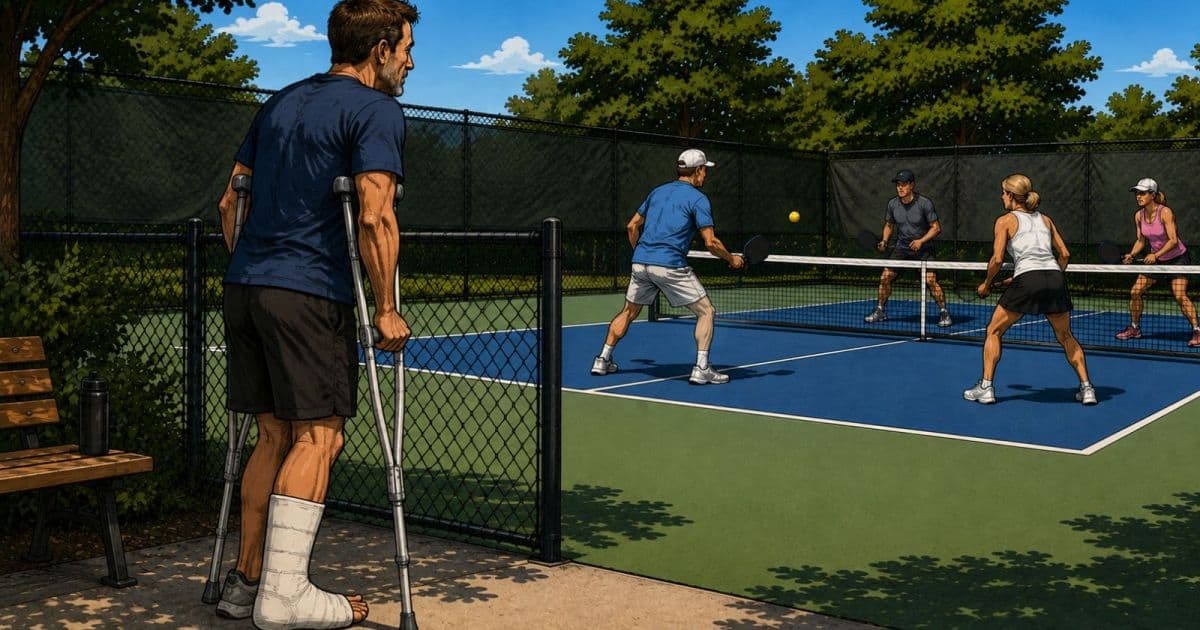
The best available picture comes from a 10 year analysis of US emergency department data covering 2013 to 2022, by Yu and colleagues. In that data, slip, trip, fall and dive mechanisms accounted for 65.5 percent of all pickleball injuries.
The injury breakdown from that emergency department data:
- Fractures: 32.7 percent, the largest diagnostic category.
- Strains and sprains: 30.8 percent, close behind.
- The wrist is the most injured body part at 12.7 percent, followed by the lower trunk at 12.1 percent and the lower leg at 11.7 percent.
Player surveys tell a different story, and it is worth keeping the two apart. A nationwide survey of 1,758 players with a mean age of 62.7 found the knee the most affected body region at 29.1 percent and the shoulder at 22.2 percent. Surveys capture the overuse aches people play through; emergency departments see the falls and fractures. This article quotes each by name rather than blending them.
Who gets hurt?
Age concentrates the risk sharply. Patients 50 and older make up about 91 percent of emergency department visits for pickleball. Within that, ages 65 to 80 account for 61.1 percent of all injuries and ages 35 to 64 for 31.3 percent.
Falls also climb with age: 65.5 percent of injuries overall, 71.5 percent in the 65 to 80 group, and 96 percent in players 81 and over.
There is a sex difference in the fracture data. An American Academy of Orthopaedic Surgeons study found that 92 percent of pickleball fractures occurred during falls, most of them upper body fractures to forearms and hands, that women 65 and older fracture more often than men, and that men were 2.3 times more likely to be admitted to hospital after a fracture, driven by more severe lower body fractures.
The rise is real but needs context. The Yu analysis estimated 66,350 injuries nationally across 2013 to 2022, climbing from 611 cases in 2013 to 13,690 in 2022, a 22 fold increase, with a 41 percent surge between 2020 and 2021. Participation grew enormously in the same period, so the raw increase partly reflects the sport’s growth, though one analysis found incidence rising faster than the sport’s popularity between 2017 and 2022.
What actually reduces the risk?
If two out of three injuries come from falling, then the interventions that matter are the ones that keep you upright.
Court shoes are the first. Running shoes are built for forward motion, and the lateral movement in pickleball rolls them. Our comparison of pickleball and tennis shoes covers what a court outsole does differently.
Movement habits are the second. Backpedaling for lobs is a commonly cited fall mechanism, and the safer pattern is turning and running or letting the ball bounce. The specific contribution of backpedaling has not been measured in the data, so treat this as sound coaching rather than a statistic, with the fall and fracture link behind it well documented: 92 percent of fractures happen in falls, most onto forearms and hands.
Training load is the third. If you went from twice a week to daily, that is a risk change. Ramping up gradually works, and balance training has its own case, which our guide to pickleball and fall prevention covers.
Stretching keeps its place, honestly sized: warming up and post play stretching help the strain and sprain share of injuries, which is 30.8 percent, and they do not address falls. Treat footwear and movement as the priority and our post play stretches as a complement.
Which injuries need a doctor?
This article is general information, not medical advice.
Get evaluated for any injury involving a pop or snap at the moment of injury, immediate swelling, an inability to bear weight, joint instability, numbness or tingling, or pain that is not improving after a week or two of rest.
Anyone over 50 who falls onto an outstretched hand should take wrist pain seriously given the fracture pattern in the data. Anyone with osteoporosis, a balance disorder, a prior fracture, or a diagnosed joint condition should talk to a doctor before increasing play, not after something goes wrong.
Frequently asked questions
What is the most common pickleball injury? In emergency department data, fractures at 32.7 percent and strains or sprains at 30.8 percent are the two most common diagnoses, and the wrist is the most injured body part at 12.7 percent.
How do most pickleball injuries happen? Slips, trips, falls and dives account for 65.5 percent of injuries in emergency department data. Most people are hurt by contact with the ground rather than by overuse.
Are older players at higher risk? Patients 50 and older account for about 91 percent of emergency department visits for pickleball injuries. Our guide on whether pickleball is safe for seniors covers this in detail.
What is the single best thing I can do to avoid injury? Wear proper court shoes and change the habits that put you on the ground, backpedaling for lobs above all. Falls cause about two thirds of injuries, so staying upright is the highest value target.
Does stretching prevent pickleball injuries? Warming up and post play stretching help the strains and sprains, but they do not address falls, which cause most injuries. Treat footwear and movement habits as the priority.
When should I see a doctor? Any pop or snap at the moment of injury, immediate swelling, inability to bear weight, joint instability, numbness, or pain not improving after a week or two.
Is the injury rate actually rising? Yes. The 10 year emergency department analysis found injuries rising from 611 in 2013 to 13,690 in 2022, a 22 fold increase. Participation grew enormously in the same period, though one analysis found incidence rising faster than the sport’s popularity.
Do overuse injuries matter too? Yes. In player surveys, knee at 29.1 percent and shoulder at 22.2 percent lead the self reported problems, which is the overuse picture the emergency data does not capture.
Most pickleball injuries are falls, and falls respond to footwear and footwork rather than to stretching alone. Put the effort where the injuries are.
Written by the Pickler Junction Team.