Choosing the Right Outdoor Pickleball Court Surface Material
Quick Answer: Most outdoor courts use acrylic coating over a concrete or asphalt base. Standard acrylic runs about $7,000 to $12,000, cushioned acrylic $15,000 to $26,000, and outdoor modular tile roughly $7,000 to $30,000. Cushioned systems cost more upfront and are easier on joints. Every coated surface needs periodic recoating.
The surface is the layer players actually feel, and it drives both the playing experience and a good share of the long-term budget. Here is how the realistic options compare.
What are the main outdoor surface options?
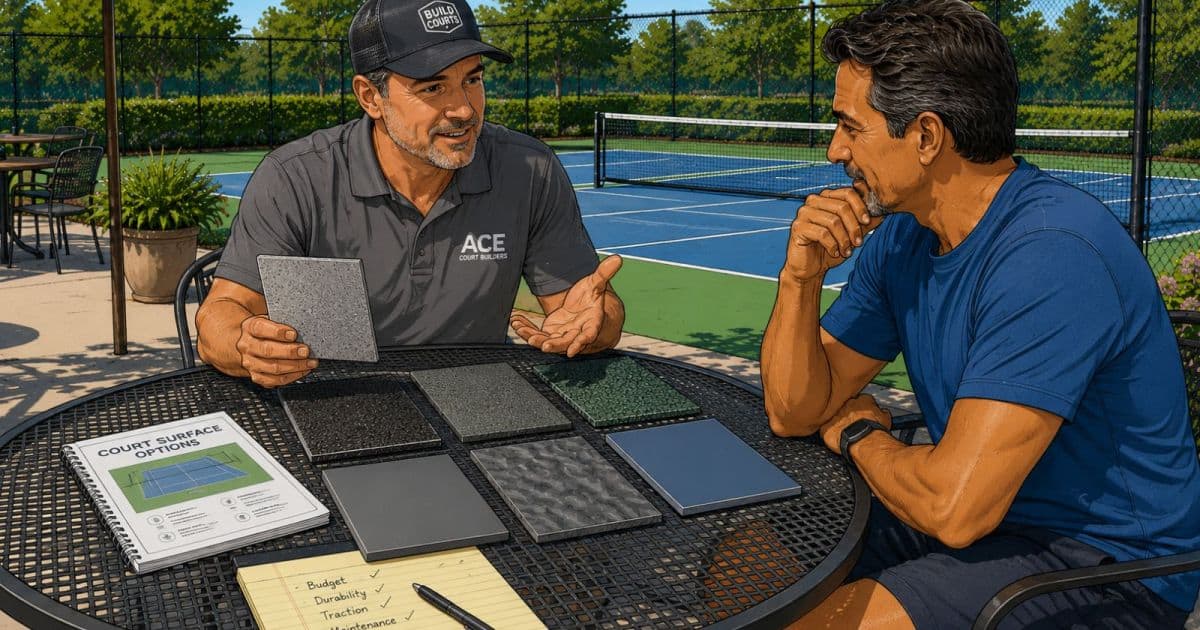
Three systems cover almost every outdoor court built today. They sit on top of a base, which is a separate decision covered in our guide to concrete versus asphalt bases.
The options:
- Standard acrylic coating. The default. A layered acrylic system applied over the base, textured for grip and colored for the playing area. Roughly $7,000 to $12,000 for a regulation court.
- Cushioned acrylic. The same idea with rubberized layers underneath for shock absorption. Roughly $15,000 to $26,000.
- Modular tile. Interlocking plastic tiles laid over the base. Roughly $7,000 to $30,000 for an outdoor court, with strong shock absorption and a much faster install.
For context on where surfacing sits in a full build, total outdoor court construction generally runs $15,000 to $70,000 or more, with a national average near $34,000. See our full cost breakdown.
How do the surfaces differ in play and upkeep?
Feel, joint impact, and maintenance cycle are where they separate.
Standard acrylic gives the most familiar ball bounce and the truest, most predictable footing. It is the reference point for how a court is expected to play. The tradeoff is that it is unforgiving underfoot, because there is nothing between you and the slab.
Cushioned acrylic keeps that same playing feel while taking noticeable load off ankles, knees, and hips. For clubs serving older players, or anyone building a court they intend to use several times a week for years, it is the option most worth the premium.
Modular tile behaves differently. The interlocking surface flexes, drains fast after rain, and installs in a fraction of the time because there is no cure-and-coat cycle. The ball response is slightly different from acrylic, which is worth testing before you commit.
When planning a first court, weight maintenance more heavily than seems necessary. Every coated surface is a recurring cost, not a one-time purchase. Acrylic systems need periodic recoating on a cycle measured in years, and that line item never goes away.
Which surface makes sense for your project?
It depends on how the court gets used, and on whether you are optimizing for day-one cost or twenty-year cost.
A rough guide:
- Tight budget, standard use: standard acrylic over asphalt. Lowest entry cost, familiar play, accept the recoating cycle. Our guide on building without cutting corners covers where saving money actually hurts.
- Frequent play or older players: cushioned acrylic over concrete. Highest upfront, best joint comfort, and concrete plus cushion frequently costs less across twenty years than the cheaper build does.
- Fast install, drainage problems, or a resurfacing job: modular tile. Goes down quickly and handles standing water well.
- Backyard courts: run the numbers on our backyard court cost guide first, since surfacing choice shifts the total meaningfully at that scale.
Whatever you choose, confirm the dimensions before surfacing, since color-coating a court that was laid out wrong is an expensive correction. Our court dimensions guide has the numbers.
Frequently asked questions
What is the best surface for an outdoor pickleball court? Acrylic coating over a concrete base is the most common choice for durability and play quality. Cushioned acrylic is better for joints, and modular tile is better for fast installation and drainage.
How much does pickleball court surfacing cost? Standard acrylic runs roughly $7,000 to $12,000 for a regulation court, cushioned acrylic $15,000 to $26,000, and outdoor modular tile roughly $7,000 to $30,000.
Is cushioned acrylic worth the extra cost? For frequent play or older players, usually yes. It reduces impact on ankles, knees, and hips, and concrete with a cushioned surface often costs less over twenty years despite the higher upfront price.
How often does an acrylic court need recoating? Acrylic systems need renewal on a cycle measured in years rather than decades. Budget for it as a recurring maintenance line, not a one-time expense.
Can you put modular tile over asphalt? Yes, modular tiles install over either concrete or asphalt bases. They also drain quickly, which makes them useful where standing water has been a problem.
Does the surface change how the ball bounces? Somewhat. Standard and cushioned acrylic give a similar, predictable bounce. Modular tile can play slightly differently, so try one before committing to a full court.
What does a full outdoor court cost to build? Generally $15,000 to $70,000 or more, with a national average near $34,000. Base material and surface system are the two biggest swing factors.
Surface choice sets both how the court plays and what it costs to keep. Price the base and the surface together rather than separately, and work it through with a specialist from our court construction directory.
Written by the Pickler Junction Team.