How Does Paddle Texture Create Spin?
Quick Answer: Pickleball paddle texture creates spin by gripping the ball for a fraction longer at contact, so a brushing swing can drag the ball into rotation instead of sliding across it. Raw carbon weaves and gritty surfaces do this best. Texture wears smooth over time, and the rules cap how rough a face can be.
Spin is the single most marketed paddle feature in the sport, and the physics behind it is refreshingly simple. Everything comes down to what happens in the few thousandths of a second the ball spends touching your paddle.
How does paddle texture create spin?
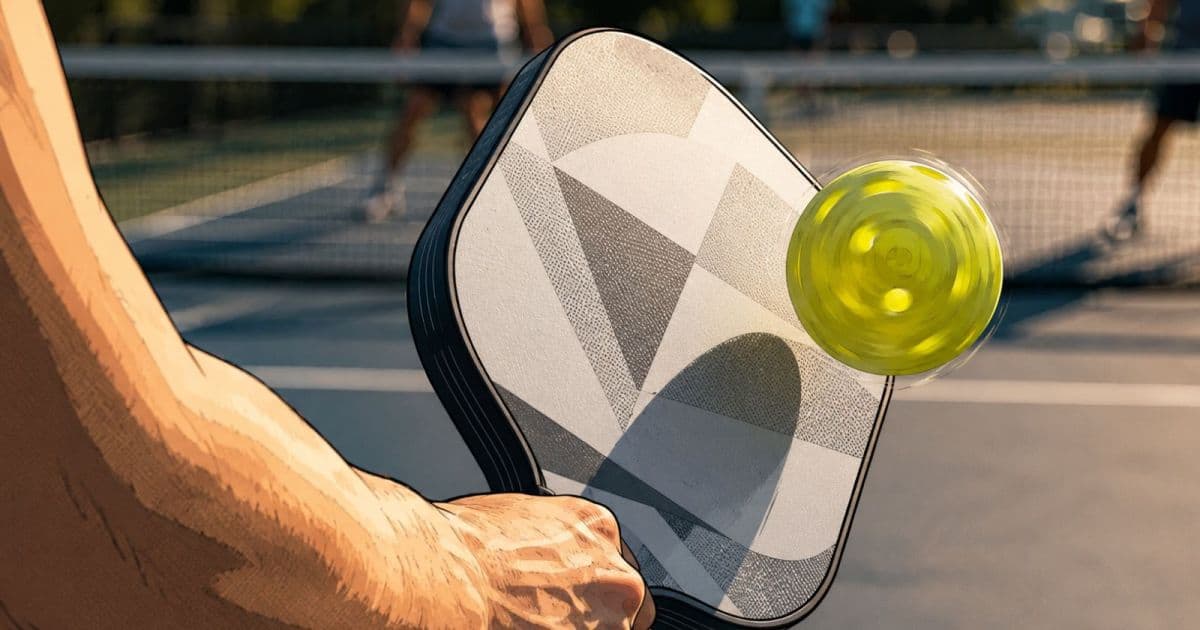
Friction, applied during a very short window. Ball and face are in contact for only a few thousandths of a second. In that window, if the paddle is moving across the ball rather than straight through it, one of two things happens.
On a slick face, the ball slides. Energy that could have become rotation is lost, and the shot comes off flatter than you intended. On a textured face, the surface grabs the ball’s skin, the contact point drags along with the paddle, and the ball leaves rotating. Same swing, different result, purely because of the surface.
That is why texture only pays off with the right swing. Brushing up the back of the ball produces topspin. Cutting down and across produces slice. Hitting flat into the ball produces almost no spin regardless of what your paddle face is made of.
Does more texture always mean more spin?
Up to a point, then no. Once a surface holds the ball well enough that it is not sliding, extra roughness adds very little, and the rules stop you well before you would reach any theoretical maximum anyway.
What separates paddles at the top of the range is less about raw grit and more about the whole package:
- Face material and weave, where exposed carbon outperforms painted composite.
- Core thickness, since a thicker core, 16mm rather than 14mm, holds the ball on the face a touch longer.
- Swing weight, because a paddle you can accelerate is a paddle that can brush.
- Surface condition, which is the one most players ignore until it is gone.
A dirty face loses grip fast. Ball residue and court dust fill the texture and make a gritty paddle behave like a smooth one, and a wipe with a damp cloth restores more spin than most players expect.
Why do textured faces wear out?
Because the texture is a physical peak-and-valley surface, and dragging a plastic ball across it thousands of times flattens the peaks. Nothing is defective about it. It is the same reason tires go bald.
Raw carbon faces are especially honest about this, since there is no coating hiding the wear. Heavy hitting and spin-heavy play wear the bite down over months rather than years. The paddle still works. It just stops doing the one thing you bought it for, which our guide to raw carbon paddles covers in more detail.
You cannot legally restore it. Sanding or scuffing a face to bring back grit is exactly the modification the rules prohibit, and it takes an approved paddle out of compliance permanently.
Are gritty paddles legal?
Approved models are, and homemade roughness is not. Surface roughness is one of the specifications tested during equipment approval, and the Equipment Standards Manual sets the limits: an average no greater than 30 micrometers on the Rz readings and no greater than 40 micrometers on the Rt readings. Every paddle on the approved list has been measured against those figures and cleared. Buying an approved paddle means you are inside the limit without having to think about it.
Where players get in trouble is after purchase. Sanding the face, applying grip sprays or films, or adding stickers to the hitting surface all void approval, and a referee can remove the paddle from play. Our guide to what USA Pickleball approved means walks through what is tested and what voids it.
How much does technique matter compared with texture?
More, and it is not close. A player with a clean brushing swing and a mid-priced paddle will out-spin a flat hitter holding the grippiest paddle on the market. Texture multiplies what your swing is already doing, and multiplying zero still gives you zero.
The mechanics worth drilling are low-to-high swing path, a relaxed grip that lets the paddle accelerate, and contact out in front where you still have room to brush. A player convinced they need a spinnier paddle is usually pushing through the ball rather than up the back of it. Fixing the swing path drops the dinks with the same paddle. Spin shows up most usefully on the shots that need to dive, which is why it matters so much on the third shot drop.
FAQ
Does a textured paddle really add spin? Yes, meaningfully, but only in combination with a brushing swing. On a flat swing path, surface texture changes very little.
How long does paddle texture last? It fades gradually with use. Frequent play tends to reduce grip within several months; casual play can stretch that to a year or more.
Can you sand a paddle to add grip? No. Modifying the hitting surface voids the paddle’s approval and makes it illegal for sanctioned play, even if the model is on the approved list.
Does cleaning a paddle restore spin? It restores grip lost to dirt and ball residue, which is often more than players assume. It cannot restore texture that has genuinely worn away.
Do thicker paddles spin more? Thicker cores tend to hold the ball on the face slightly longer, which can help. Face material and swing path still matter more.
Is spin more important than power? For most players, yes. Spin creates margin, letting you swing harder while the ball still drops in, which is a bigger advantage than raw pace.
Do spin sprays or grip enhancers work? Applying anything to the face is not legal for sanctioned play, and residues tend to attract dirt that reduces grip rather than improving it.
Looking for a paddle that actually matches your swing? Our gear and accessories directory is a good place to compare, and an hour with one of the coaches near you will do more for your spin than any face material on the market.
Written by the Pickler Junction Team.