What Is Pickleball Paddle Delamination?
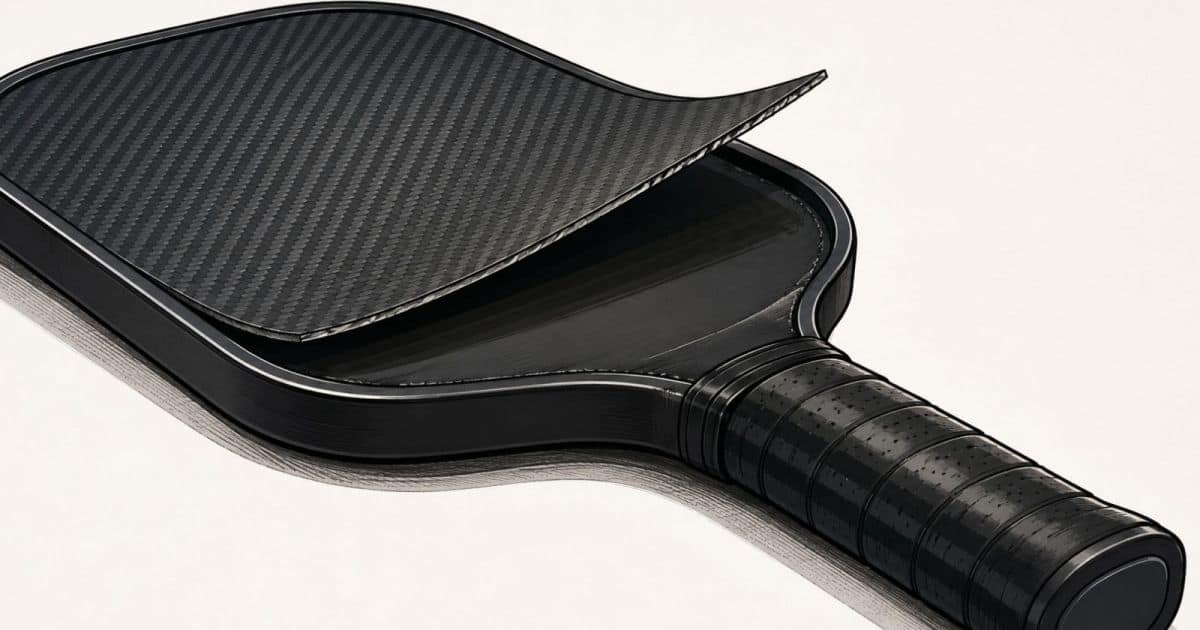
Quick Answer: Pickleball paddle delamination is the carbon or fiberglass face separating from the honeycomb core underneath. The gap makes the face act like a trampoline, so the ball leaves hotter and less predictably. Delaminated paddles are not legal in sanctioned play, and the usual signs are a rattling sound and a hollow feel.
Modern paddles are layered products. A thin face is bonded to a honeycomb core, and the whole sandwich is held together by adhesive. Delamination is what happens when that bond fails, and it changes how the paddle plays before most owners realize anything is wrong.
What is paddle delamination?
It is a bond failure between the face and the core. Once the face is no longer glued flat to the honeycomb beneath it, that unsupported area flexes independently on contact and springs back, launching the ball faster than the paddle was designed to.
The result is inconsistency rather than a clean upgrade. Shots off the delaminated area fly long. Shots off a still-bonded area behave normally. You end up with a paddle that plays like two different paddles depending on where the ball lands, which is why players often describe a growing accuracy problem before they suspect the equipment.
What causes a paddle to delaminate?
Some combination of manufacturing, use, and abuse. Common contributors:
- Adhesive failure from a weak or uneven bond at the factory.
- Repeated hard impact that fatigues the bond over many sessions.
- Heat cycling, especially a paddle left in a hot car where the adhesive softens and re-cures.
- Edge damage from paddle taps, court scrapes, or drops, which lets the bond start peeling from the perimeter.
- Thin, hot builds that run closer to the limits of what the construction can take.
Core crushing is a related but separate problem, where the honeycomb cells collapse instead of the face detaching. Both produce a dead spot, and both mean the paddle is finished.
How do you know if your paddle is delaminated?
Sound is the fastest test. Tap the face lightly with a knuckle across the whole surface. A healthy paddle gives a consistent, solid tick. A delaminated area sounds hollow, buzzy, or rattly compared with the rest of the face.
Then check feel and behavior:
- Listen at contact. A rattle or a tinny ring on hits is a warning sign.
- Look at the edge guard. Bubbling, lifting, or a visible seam gap along the perimeter often shows first.
- Watch your depth control. If drives that used to land in are suddenly sailing, the paddle may be adding pace you did not.
- Press the face gently. Any area that flexes or oil-cans differently from the rest is suspect.
A knuckle tap can reveal the difference between the top third and the bottom two thirds from arm’s length, long after the owner has started blaming a slump on their footwork.
Is playing with a delaminated paddle legal?
No, not in sanctioned competition. A delaminated paddle no longer performs the way the paddle that passed approval performed, so it falls outside the equipment standards, and tournament officials can pull it. That is true even if the model itself is on the approved list, because approval covers the paddle as manufactured.
Recreational play has no enforcement, but it has etiquette. A delaminated paddle gives you extra pop your opponents did not sign up for, and most regular groups treat knowingly playing one the way they treat a cracked ball. The practical answer is simple: if it sounds wrong, retire it. Our guide to what USA Pickleball approved means covers how equipment standards work and why they exist.
Can you prevent or fix delamination?
You cannot reliably fix it. Injecting glue into a failed bond does not restore uniform support across a honeycomb core, and the paddle will not return to the way it played new. Once a paddle is delaminated, its playing life is over, and a warranty claim is usually the only path worth pursuing.
Prevention is mostly about heat and impact. Keep the paddle out of hot cars and direct sun, which is the single biggest controllable factor, and our guide on storing pickleball paddles covers the rest. Ease up on hard paddle taps with a chipped edge guard, and stop using a paddle to scoop balls off the court, which grinds the perimeter where bonds start to fail.
Buying quality helps too, though price alone guarantees nothing. If you are weighing what to spend, our breakdown of how much to spend on a pickleball paddle covers where the money actually goes.
FAQ
How can you tell if a paddle is delaminated? Tap the face with a knuckle and listen for hollow or rattly spots, watch for a lifting edge guard, and notice whether shots are suddenly flying long.
Does delamination make a paddle better? It makes it hotter and less predictable, which some players mistake for an upgrade. Control and consistency drop, and the paddle is not legal for sanctioned play.
Is delamination the same as core crush? No. Delamination is the face separating from the core. Core crush is the honeycomb collapsing. Both create dead or unpredictable spots and both end the paddle’s life.
Can a delaminated paddle be repaired? Not to original condition. Glue injection does not restore even support across the core, so replacement or a warranty claim is the realistic option.
Does heat cause delamination? Heat is a major contributor. A paddle left in a hot car can soften the adhesive, and repeated heat cycles weaken the bond over time.
How long should a paddle last before this happens? Most paddles never delaminate and simply wear out their face texture and grip first. When it does happen, it usually shows up after months of heavy play or a specific heat or impact event.
Will a warranty cover delamination? Often yes, within the warranty window, since it is generally treated as a manufacturing defect. Keep your purchase receipt and contact the manufacturer before modifying the paddle.
Shopping for a replacement or a backup? Our gear and accessories listings are the place to start, and if you are heading into sanctioned events, check the tournaments and events directory for what you are signing up for.
Written by the Pickler Junction Team.