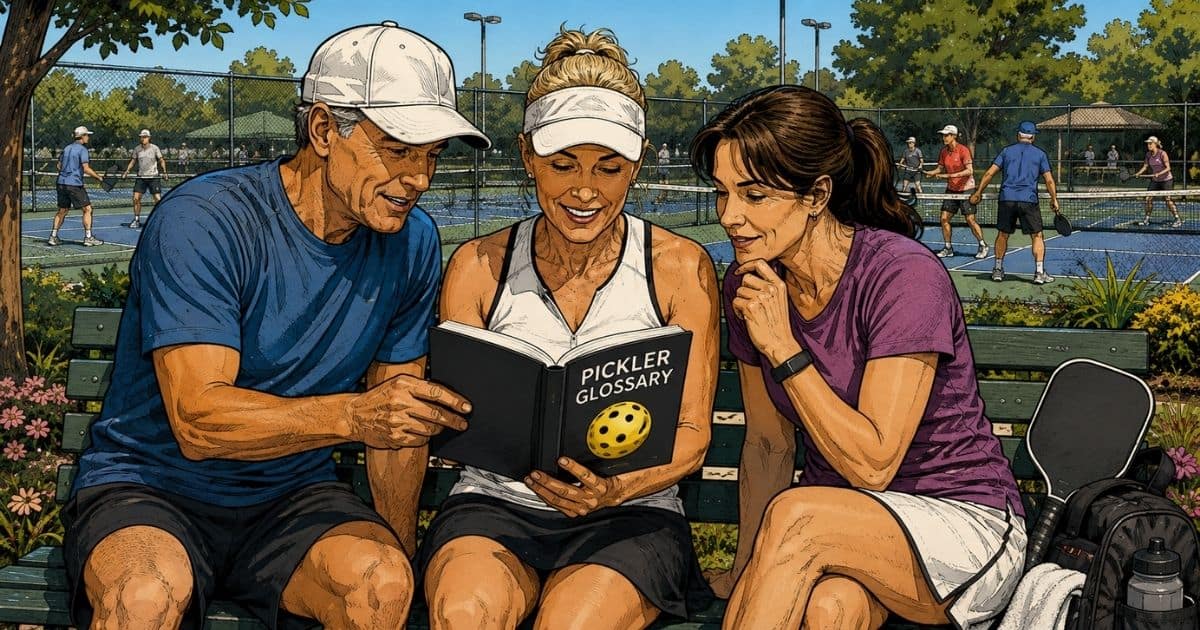
Pickleball Terminology: A Complete Glossary
Quick Answer: Pickleball terminology blends official rulebook language with invented court slang. Terms like the two-bounce rule, non-volley zone, fault, and side out are defined under the 2026 rulebook. Names like dink, Erne, and banger came from players. This glossary defines both groups, organized by theme.
Pickleball runs two vocabularies at once. One is precise and legal, written into the rulebook and enforced by referees. The other grew out of driveways and rec centers, and produced words like falafel, volley llama, and Nasty Nelson. New players hear both on day one and cannot tell them apart. This glossary separates them: rules terms are stated as the 2026 rulebook states them, and slang is labeled as slang, with its origin where known.
What Are the Core Pickleball Rules Terms?
Two-bounce rule. The serve and the return of serve must each bounce before being returned, under the 2026 rulebook. Only after those two bounces may either side hit the ball out of the air. The two-bounce rule is the official name.
Volley. A strike of the ball before the ball bounces, under the 2026 rulebook. A volley is legal only when the player starts it with both feet outside the non-volley zone and its lines, and momentum that carries the player into the zone afterward is a fault under the 2026 rulebook. The breakdown of what a volley is in pickleball covers technique and legal limits.
Non-volley zone. The 7 foot by 20 foot area on each side of the net where players may not volley, under the 2026 rulebook. All lines bounding the zone are part of the zone. The complete rule set lives in the guide to pickleball kitchen rules.
Kitchen. The universal nickname for the non-volley zone. The name has nothing to do with cooking, and the story behind why it is called the kitchen traces to an older shuffleboard usage.
Fault. A rules violation that results in a dead ball and the loss of the rally, under the 2026 rulebook. The list of what counts as a fault in pickleball runs through the full catalog.
Side out. The awarding of the serve to the opposing side after a player or team loses its serve, under the 2026 rulebook. In doubles both partners must lose their serve first, as the explainer on what a side out is lays out.
Momentum. A property of a body in motion that causes a player to continue moving after contacting the ball, under the 2026 rulebook. It ends when the player regains balance and control or stops moving toward the non-volley zone, and momentum that carries a volleying player into the zone is a fault, even after the ball is dead.
Let. A rally that gets replayed. The service let was removed in January 2021, so a serve that clips the net and lands in the correct service court is live under the 2026 rulebook.
Carry. Hitting the ball so that it does not bounce away from the paddle but is carried along on the paddle face, which is a fault under the 2026 rulebook.
Volley serve and drop serve. The two legal serves under the 2026 rulebook. The volley serve is struck out of the air with an upward arc and contact below the waist. The drop serve is dropped and struck after the bounce, with no motion restriction.
Chainsaw serve. A retired technique in which the server spun the ball against the paddle before striking it. It is now illegal, because the 2026 rulebook bars the server from imparting manipulation or spin on the release of the ball.
What Do Players Call the Parts of the Court?
Kitchen line. The non-volley zone line, 7 feet from the net. It is part of the zone, so touching it while volleying is a fault under the 2026 rulebook.
Transition zone. The stretch between the non-volley zone line and the baseline, also called midcourt or no man’s land. The guide to the transition zone explains why players move through it rather than stand in it.
Pickledome. The show court where a tournament’s title match is played.
What Are the Main Pickleball Shot Names?
Dink. A soft shot hit from at or near the non-volley zone line that arcs over the net and lands in the opponent’s non-volley zone, kept low enough to be unattackable. The treatment of what a dink is covers grip, contact point, and placement.
Drive. A hard, low groundstroke hit from the backcourt or midcourt. The guide to the pickleball drive covers when power beats patience.
Lob. A shot hit in a high arc over the opponent’s head, aimed at the backcourt to push a net player backward. The strategy behind the pickleball lob covers offensive and defensive versions.
Reset. A soft, absorbing shot usually hit from midcourt that drops harmlessly into the opponent’s non-volley zone and neutralizes their attack. The mechanics of the reset shot come down to soft hands and a still paddle.
Speed-up. A sudden change of pace where a player attacks a slow dink to catch opponents flat. The timing rules for the speed-up decide whether it wins the point or hands it away.
Third shot drop. The serving team’s soft third ball, dropped into the opponent’s non-volley zone so the serving team can advance to the net. Its aggressive counterpart is the third shot drive, and the comparison of the third shot drive versus the third shot drop explains which situation calls for which.
ATP. Short for around the post, a shot hit outside the net post that lands in the opponent’s court. It is legal at any height, including below net level, and the breakdown of the around the post shot covers the setup that creates it.
Falafel. Slang for a shot hit with far less power than intended.
Flapjack. Slang for a shot that must bounce before it can be legally hit, meaning the first two shots of any rally under the 2026 rulebook.
Dillball. Slang for a ball that has bounced once in bounds and is still live.
Which Pickleball Terms Are Named After Real People?
Erne. A volley hit by a player standing outside the sideline next to the net, or leaping over the corner of the non-volley zone, so the ball can be struck close to the net without a non-volley zone fault under the 2026 rulebook. Dictionary.com states it is named after player Erne Perry, who popularized it. The guide to the Erne covers both legal versions.
Bert. An Erne executed on a partner’s side of the court, so the player crosses in front of the partner to hit it. Dictionary.com notes the name plays on the Muppet pairing of Bert and Ernie.
Nasty Nelson. A serve aimed at the receiver’s partner, the player standing at the net who is not receiving. Dictionary.com states it is named for player Timothy Nelson, who popularized it. It is a legal play, because a served ball that contacts the receiver’s partner before landing is a fault against the receiving team under the 2026 rulebook.
What Do the Doubles and Strategy Terms Mean?
Banger. A player who hits nearly everything hard, relying on power instead of the soft game. Bangers dominate at lower levels and stall out against players who reset, which is the core of the playbook for how to beat a banger.
Poaching. Crossing into a partner’s side of the court to intercept a ball, usually a volley at the net. The tactical rules for poaching in doubles cover when it helps and when it leaves a hole.
Stacking. A doubles alignment where partners set up on the same side of the centerline before the serve or return, then switch after the ball is struck, so each stays on a preferred side.
Hand signals. Signals given behind the back by the net partner before a serve or return, telling the other partner whether the pair will switch or stay. The guide to hand signals in pickleball doubles covers the standard set and the verbal confirmation that goes with it.
Skinny singles. A half-court singles game played on the diagonal, used as a drill because it forces placement instead of running.
Volley llama. Slang for volleying while standing in the non-volley zone, which is a fault under the 2026 rulebook.
What Do the Rating Terms Mean?
DUPR. Short for Dynamic Universal Pickleball Rating, a global system on a 2.000 to 8.000 scale using a modified Elo algorithm that weighs opponent strength, match score, recency, and match type. Both recreational and tournament matches count. The explainer on what a DUPR rating is covers how to get one.
Skill levels. The 2.5, 3.0, 3.5, 4.0, 4.5, and 5.0 labels used to sort open play and tournament brackets. They describe shot reliability and tactical awareness rather than athletic ability.
Sandbagging. Entering a tournament at a level below a player’s actual rating to win easier medals. The look at pickleball sandbagging covers how organizers police it.
What Are the Scoring and Outcome Terms?
Pickled. Losing a game 11-0.
Golden pickle. Losing 11-0 without ever getting the serve, meaning the first server ran the entire game. The explanation of what a golden pickle is notes that the term is community slang and does not appear in the rulebook.
OPA. A shout some groups use after the third shot to signal that the two-bounce rule is satisfied and open volleying is now allowed under the 2026 rulebook.
Rally scoring. A format awarding a point after every rally regardless of who served, used in some events. Traditional side-out scoring, where only the serving side scores, remains the default, and games run to 11, win by 2, as the standard format.
Frequently Asked Questions About Pickleball Terminology
Is the kitchen an official term? No. The rulebook calls it the non-volley zone under the 2026 rulebook. Kitchen is universal slang that referees and players use anyway.
What is the difference between a dink and a drop? Both land soft in the opponent’s non-volley zone. A dink is hit from at or near the non-volley zone line during a slow exchange, and a third shot drop is hit from the baseline or midcourt to buy time to move forward.
Is a carry legal in pickleball? No. Carrying the ball along the paddle face is a fault under the 2026 rulebook, and intent does not matter.
Do let serves still exist? No. A serve that hits the net and lands in the correct service court is live and must be played under the 2026 rulebook, since the service let was removed in January 2021.
Is the Nasty Nelson a legal shot? Yes. A served ball that contacts the receiver’s partner before landing is a fault against the receiving team under the 2026 rulebook, so the serving side wins the rally.
What is the difference between being pickled and a golden pickle? Both end 11-0. Being pickled means losing without scoring. A golden pickle means losing without scoring and without ever serving.
Why is the chainsaw serve gone? The 2026 rulebook prohibits the server from imparting manipulation or spin on the release of the ball, which eliminates every pre-spin technique. Paddle-generated spin is still legal.
What does sandbagging mean in a tournament? It means registering in a bracket below a player’s real skill level to collect an easier medal. Tournaments increasingly use rating verification to limit it.
Terminology sticks fastest when the words get spoken in a live game. Local sessions are listed in the public pickleball courts directory, and a coach who can translate the vocabulary in real time can be found in the pickleball coaches directory.
Written by the Pickler Junction Team.