Indoor vs. Outdoor Pickleball Court Lighting: What You Actually Need
Quick Answer: Indoor courts use ceiling-mounted fixtures and outdoor courts use pole-mounted fixtures around 20 feet high. Light levels are set by facility class, not by indoor versus outdoor: 30 foot-candles for recreational play, 50 for club and competitive, and 75 or more for tournament play, in either setting. Indoor lighting is easier to aim and shield, while outdoor lighting must also handle glare, weather, and light trespass onto neighboring property.
The lighting goal is the same indoors and out (even, glare-free light that makes the ball easy to track) but how you get there is quite different. Here is what you actually need for each.
How does indoor and outdoor court lighting differ?
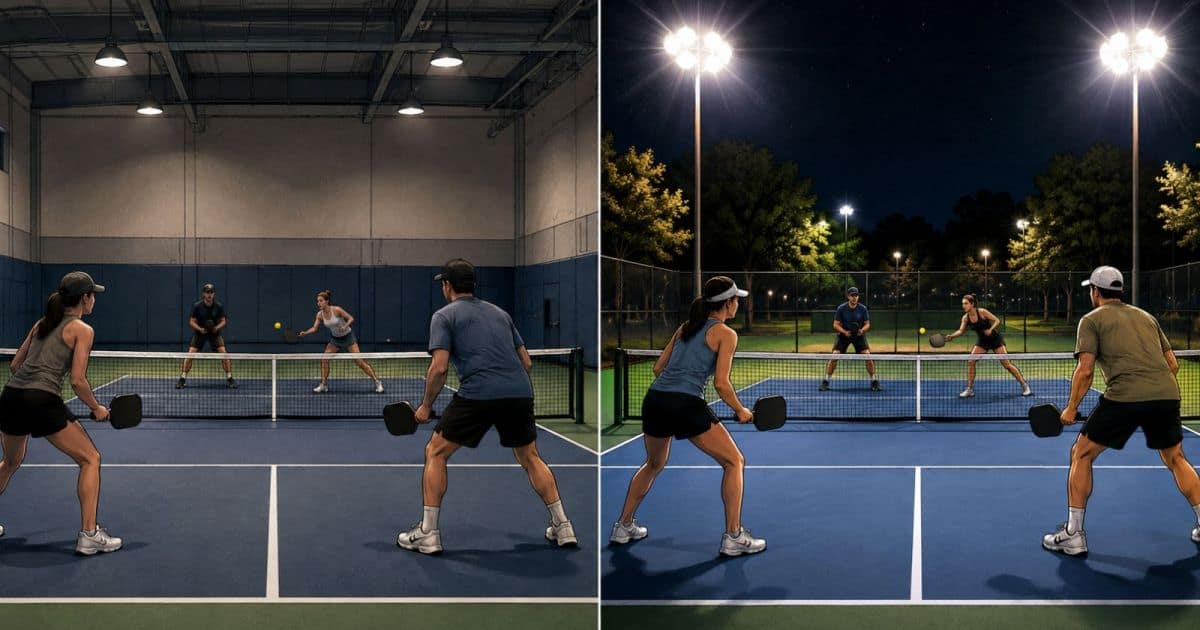
Ceiling mounts versus poles, with different challenges. The biggest difference is where the fixtures go, which drives almost everything else about the design.
The core differences:
- Indoor: ceiling-mounted fixtures, easier to achieve even coverage and shielding.
- Outdoor: pole-mounted fixtures (about 20 feet high) on the sides, needing forward-throw optics to push light onto the court.
- Indoor challenges: ceiling height, fixture spacing, and glare from low ceilings.
- Outdoor challenges: glare, weather resistance, and light trespass onto neighbors.
Indoor lighting is the more forgiving of the two. Outdoor lighting has to fight weather, glare on lobs, and the neighbors’ patience all at once.
What brightness does each need?
30 foot-candles recreational, 50 club and competitive, 75 tournament, in either setting. The targets are set by facility class, and the environment changes how you hit them.
The brightness targets:
- Recreational (either setting): minimum 30 maintained foot-candles.
- Club and competitive (either setting): 50 foot-candles.
- Tournament and broadcast (either setting): 75 foot-candles or higher.
- Uniformity: a max-to-min ratio of 2.0 at the recreational and club tiers, tightening to 1.7 for tournament play.
Indoors, you control all the light, so consistency is easier. Outdoors, you also deal with changing ambient conditions and the need to keep spill off neighboring property. For the full numbers, see our guide on lighting standards.
What does each setting require in practice?
Different fixtures, mounts, and considerations.
For indoor courts:
- Ceiling-mounted LED fixtures positioned to avoid glare in players’ eyes.
- Adequate ceiling height so fixtures clear lobs. Court builders commonly ask for at least 18 feet of clear height, with 20 feet or more preferred. See our indoor sizing guide.
- Glare and shadow control, plus attention to acoustics in gyms.
For outdoor courts:
- Pole-mounted LED fixtures (about 20 feet) on the sides, with forward-throw optics.
- Weather-resistant fixtures built for the elements.
- Light trespass control, to comply with ordinances and keep neighbors happy.
- Dark-sky compliance where required.
Both benefit from a photometric plan before installation, which models brightness and uniformity (and outdoors, spill) so problems surface on paper instead of after the poles are set.
What do facility owners need to specify and budget?
Three numbers drive the whole project: the foot-candle target, the mounting height, and the spill limit at the property line. Get those right and most of the design follows.
Lighting levels for pickleball are codified in the ASBA Pickleball Courts Construction and Maintenance Manual and align with USA Pickleball guidance. They sort courts into three categories:
- Category III, recreational: 30 maintained foot-candles average, with a max-to-min uniformity ratio of 2.0.
- Category II, club and competitive: 50 foot-candles, at the same 2.0 uniformity.
- Category I, tournament and broadcast: 75 foot-candles or higher, tightened to a 1.7 uniformity ratio.
Mounting height is where clubs most often go wrong. Twenty feet is the standard recommendation for a dedicated outdoor court, with 18 to 25 feet the workable range. Dropping lower to save on poles puts the glare source back inside a player’s sightline on lobs and overheads, and it makes the uniformity ratio harder to hit.
For spill and glare, full-cutoff optics are the baseline. Dark-sky ordinances modeled on DarkSky International (formerly the International Dark-Sky Association) language cap uplight at 1 percent of fixture output, and residential-adjacent sites commonly carry a property-line spill limit of 0.1 to 1.0 foot-candles. Two details catch owners off guard: house-side shielding on the fixtures nearest the property line, and dark-sky compliance often requiring 3000K or warmer LEDs when most sports lighting ships at 4000K or 5000K. Some ordinances go to 2200K. Within roughly 200 feet of homes, assume you are designing to an ordinance.
Budget varies enormously, and published totals for a single outdoor court scatter from about $1,800 to roughly $52,000 depending on the source, the fixture package and the site. Treat any single figure as a starting point and get a quote. Pole height is not the variable that sets dark-sky compliance: that is decided by fixture cutoff and color temperature, so a taller pole changes the aiming problem rather than the price tier. Multi-court builds have run from about $17,200 to $122,000, and an LED retrofit of an existing system typically falls between $7,700 and $65,000. Plan one to three months from design through permitting, procurement, and final testing. Local ordinances always outrank general standards, so confirm your municipality’s rules first.
Frequently asked questions
How many foot-candles does an indoor court need? That is set by facility class rather than by being indoors: 30 maintained foot-candles for recreational play, 50 for club and competitive, and 75 or more for tournament and broadcast, with even distribution.
Why is outdoor lighting more challenging? Outdoor lighting must handle glare on lobs, weather resistance, and light trespass onto neighboring property, while also working with pole-mounted fixtures and changing ambient conditions.
Can you use the same fixtures indoors and outdoors? Not usually. Outdoor fixtures must be weather-resistant with forward-throw optics for pole mounting, while indoor fixtures are designed for ceiling mounting and controlled environments.
Do both need a photometric plan? Yes, both benefit from a photometric plan that models brightness, uniformity, and (outdoors) spill before installation, preventing costly dark spots, glare, or trespass issues.
What does it cost to light one outdoor court? Published figures range from about $1,800 to roughly $52,000 depending on source and specification, so the honest answer is to get a quote. Dark-sky compliance is set by fixture cutoff and color temperature rather than by pole height, so it is not a price tier of its own.
What foot-candle level does a club need? Recreational courts target 30 maintained foot-candles, club and competitive play 50, and tournament or broadcast play 75 or more, with uniformity tightening from 2.0 to 1.7 at the top tier.
The goal is the same, but indoor and outdoor lighting take different paths to get there. Design your system with a court construction contractor who can produce a photometric plan before anything gets ordered.
Written by the Pickler Junction Team.